
Today's past-performance sheets and picks
One past-performance sheet per race: every horse's early and late pace drawn against the field. Lone speed, closers, meltdowns — answered at a glance.
🏇 Coast to coast, piled into one card.
Every day we round up individual races from tracks all across North America — as many as the day offers — and pile them into a single daily card. Your card is never limited to one track's program.
The line tells you who. The graphs show you how. Every selection is free — no account, no subscription, no wagering promises.
One click: the past-performance sheets hold everything — every race's sheet with the pick marked, its pace projection, and the full running lines. It's all free — every race, every section, every day. Every sheet and pick is free to read; the day's races are assembled from publicly available sources on the internet.
The line tells you who. The graphs show you how. Every selection is free — no account, no subscription, no wagering promises. Want more? Members build sheets from their own files and unlock the full daily sports package.
Today’s races are assembled from the public trainer pages in our trainer directory.
Pick of the Day — Thursday, November 26, 2026
One card per area
Today’s Best Bets
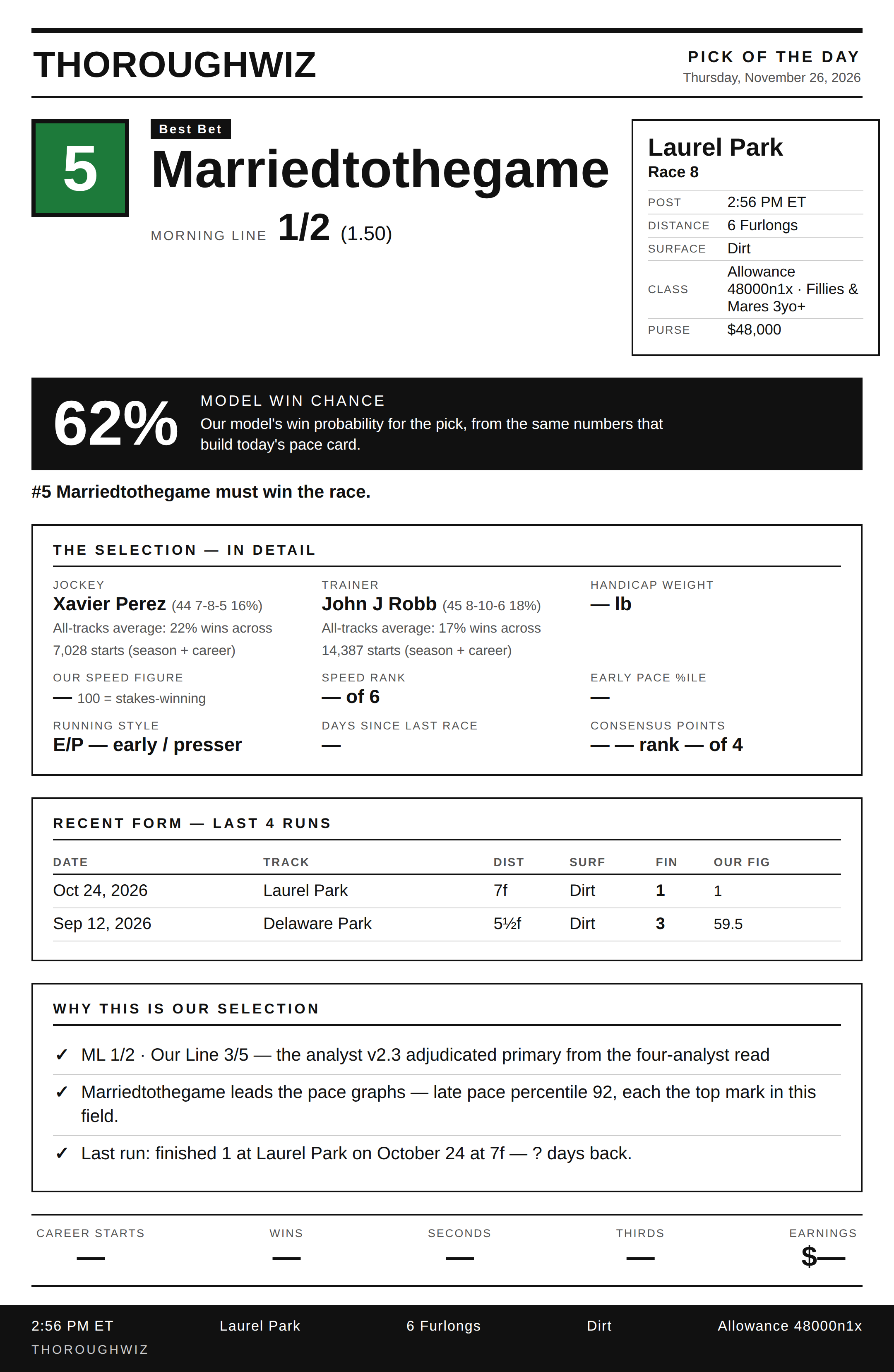
- 2:56 PM ET · Laurel Park Race 8 · Marriedtothegame · Racing
- Across the Country · Small Craft Advisory is today's most widespread alert — 178 active on the national wire (353 alerts of all kinds nationwide). Warmest Los Angeles, CA 83°; coldest Minneapolis, MN 40°. · Weather
Per-Track Reports
Today's bias and jockey and trainer tables, track by track, from the official charts. Supplemental information, descriptive only.
Today’s past-performance sheets
Our own past-performance sheet for every race on today’s card — each horse’s running lines, our figures and the pace picture, all computed by ThoroughWiz. This is the core sheet.
The line tells you who. The graphs show you how.
One click opens a race’s sheet: the pick marked, its pace projection, and the full running lines. Every selection is free to read — every race, every section, every day, with no wagering promises. Today’s card: the 20 best races by class across the tracks we cover — every race is processed and archived; these are the ones we publish.
Our data comes from free, publicly available sources on the internet. We resell nothing. Licensed material stays with its owner: official charts are © Equibase Company LLC, and where a sheet points to one, the link goes to Equibase’s own site — we do not reproduce or resell their material.
The day’s races are assembled from the public trainer pages in our trainer directory.
Jump to a track: Del Mar · Laurel Park · Churchill Downs · Fair Grounds · Gulfstream Park · Woodbine
Del Mar
- Del Mar Race 2 — post 11:31 AM ET · 5 Furlongs, Turf · Pick: #7 Ruler of Law (4/1)
- Del Mar Race 3 — post 12:02 PM ET · 6 Furlongs, Dirt · Pick: #5 Lihue Princess (5/2)
- Del Mar Race 7 — post 2:06 PM ET · 1 Mile, Dirt · Pick: #4 Good Golly Dolly (8/1)
- Del Mar Race 8 — post 2:36 PM ET · 1 3/16 Mile, Turf · Pick: #11 Kentucky Gal (6/1)
Laurel Park
- Laurel Park Race 2 — post 11:52 AM ET · 1 Mile, Dirt · Pick: #2 Ineedyoubabe (4/5)
- Laurel Park Race 3 — post 12:21 PM ET · 5½ Furlongs, Dirt · Pick: #6 Curlene's Joker (5/1)
- Laurel Park Race 5 — post 1:28 PM ET · 6 Furlongs, Dirt · Pick: #2 Naja (5/1)
- Laurel Park Race 8 — post 2:56 PM ET · 6 Furlongs, Dirt · Pick: #5 Marriedtothegame (1/2)
Churchill Downs
- Churchill Downs Race 3 — post 12:26 PM ET · 6½ Furlongs, Dirt · Pick: #1 She's Toasty (1/1)
- Churchill Downs Race 9 — post 3:16 PM ET · 1 1/8 Mile, Turf · Pick: #3 Miwa (5/1)
- Churchill Downs Race 10 — post 3:45 PM ET · 6 Furlongs, Dirt · Pick: #3 Big Jake (3/2)
- Churchill Downs Race 11 — post 4:14 PM ET · 1 1/8 Mile, Dirt · Pick: #8 Regaled (3/1)
Fair Grounds
- Fair Grounds Race 3 — post 1:00 PM ET · 1 Mile, Dirt · Pick: #2 Island Cabana (7/2)
- Fair Grounds Race 5 — post 2:00 PM ET · 6 Furlongs, Dirt · Pick: #8 Dirty Straight Up (8/1)
- Fair Grounds Race 6 — post 2:30 PM ET · 1 Mile, Turf · Pick: #5 Bearamour (6/1)
- Fair Grounds Race 9 — post 4:00 PM ET · 6 Furlongs, Dirt · Pick: #6 Cat On Time (6/1)
Gulfstream Park
- Gulfstream Park Race 8 — post 2:38 PM ET · 1 Mile, Dirt · Pick: #4 Sneak Preview (3/1)
- Gulfstream Park Race 9 — post 3:07 PM ET · 1m70yds, Synthetic · Pick: #2 Hammy (6/1)
Woodbine
- Woodbine Race 3 — post 4:08 PM ET · 5½ Furlongs, Synthetic · Pick: #3 Chinook (8/5)
- Woodbine Race 7 — post 6:09 PM ET · 1 1/16 Mile, Synthetic · Pick: #5 Carrick On Stage (12/1)
Prefer the summary? Picks (PDF) — every pick on one page
Head to Head
One reference sheet: the head-to-head board for the horses still in training, every meeting between them this year, and the races where they can still meet.
Reference
Progeny records computed from our own past-performance record: how each sire's runners finish, by surface, distance, track, sex and age.
- The Bettor’s Journal — The Outsider’s daily read of the published card: full rankings, pace, and the value call on every race
- Sire Dictionary — progeny records for the sires in our record
- American Racing, Explained — a beginner’s handbook: how the sport works, how to read the sheet, and what our own records say
- Power Ratings — the top ten horses still racing, overall and by division
- Ask the Racing Lab — search the lab’s own archive, the classic turf books and the community shelf